15
AUG
2025
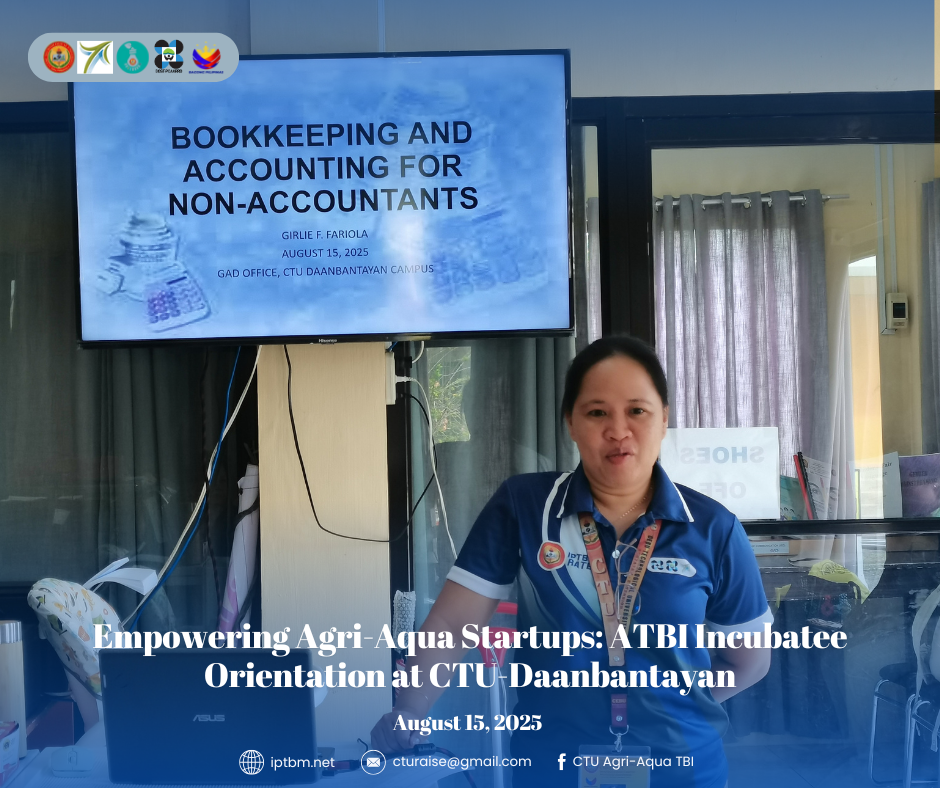


Strengthening Startups Through Financial Literacy: Fundamentals of Bookkeeping Training at CTU-Daanbantayan
This activity, led by Prof. Girlie F. Fariola as the resource speaker and supported by Prof. Marlou C. Godinez together with Ms. Nicole Letigio, was carefully designed to strengthen the financial literacy and management capacity of incubatees under the RATBI-RAISE Program. Recognizing that many startups and MSMEs often struggle with maintaining accurate and transparent financial records, the training sought to bridge this gap by equipping participants with essential bookkeeping skills.
The session began with a discussion on the theory of accounting, which laid the groundwork for understanding the principles that govern financial management. This was followed by hands-on exercises in journal and ledger entries, where incubatees had the opportunity to apply what they learned in practice. The training concluded with an overview of financial reporting, highlighting how accurate and timely financial statements serve as vital tools for assessing business performance, ensuring compliance with regulations, and guiding strategic decision-making.
More than just a technical workshop, the training underscored the broader significance of bookkeeping as a cornerstone of business integrity and sustainability. Participants came to understand that beyond balancing figures, proper financial management builds trust, instills investor confidence, and positions enterprises for long-term growth. Several incubatees shared that the activity not only enhanced their practical skills but also gave them a sense of empowerment and assurance in managing financial responsibilities that once seemed daunting.
Ultimately, this activity reflects the strong commitment of the RATBI-RAISE Program to nurture well-rounded entrepreneurs who are equipped not only with technological and innovative competencies but also with the financial discipline required to sustain their ventures. By fostering a culture of accountability, transparency, and financial responsibility, the program continues to empower local enterprises toward inclusive and sustainable development, ensuring that they can thrive in competitive markets while contributing to the socio-economic progress of their communities.
This event marks the beginning of another cycle of transformative agri-aqua enterprises, poised to strengthen financial literacy, foster innovation, and create a lasting impact on the industry and local communities.